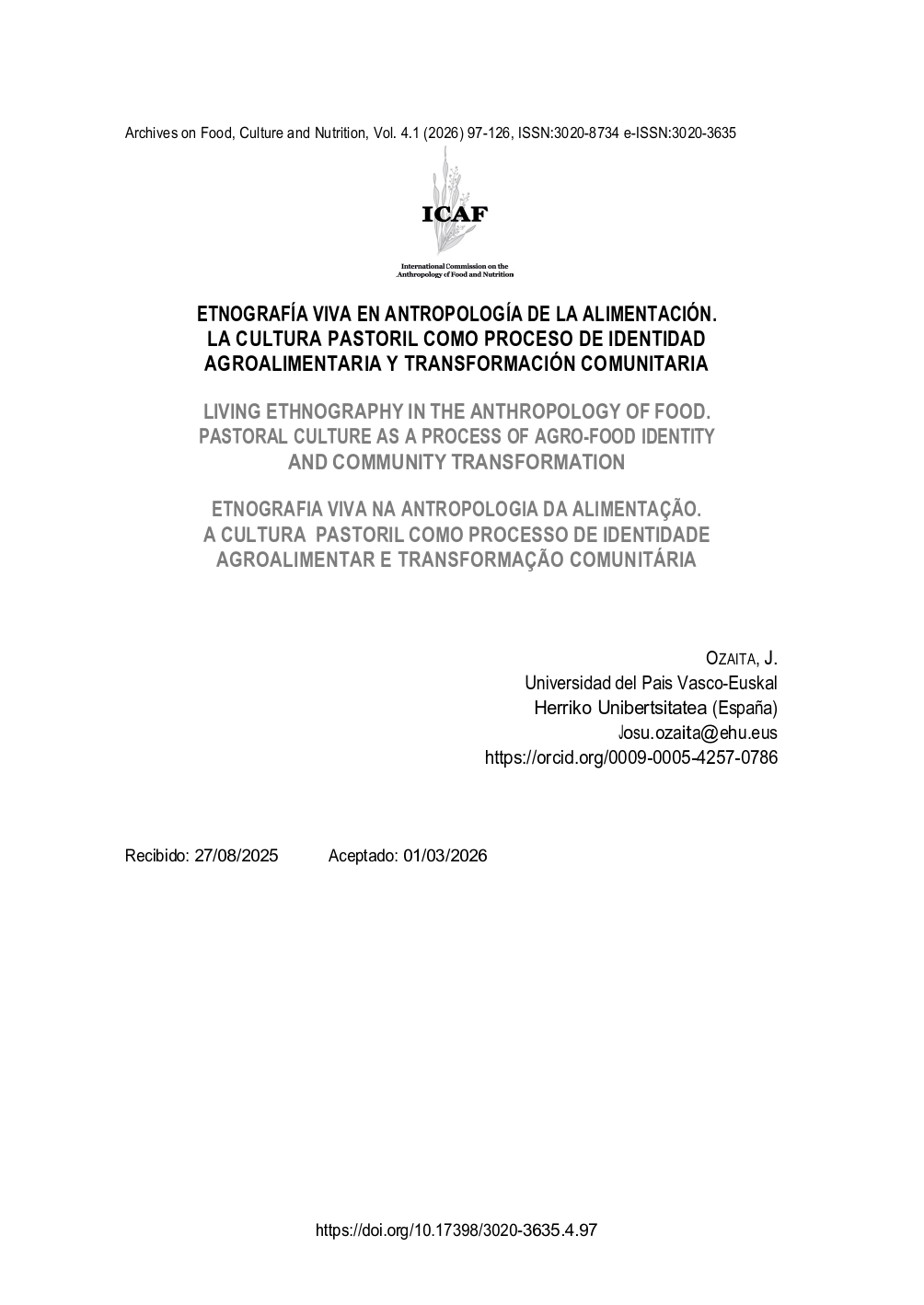
Living ethnography in the anthropology of food
Pastoral culture as a process of agro-food identity and community transformation
DOI:
https://doi.org/10.17398/3020-3635.4.97Keywords:
Living ethnography, invention of the future, anthropological intuition, ontological turn, embodiment of foodAbstract
This article presents a case of living ethnography applied to food anthropology in Berastegi (Basque Country), demonstrating how ethnographic research transcends descriptive documentation to become a tool for community transformation. Starting from a collaborative and participatory methodological approach, the author combines traditional data collection techniques with collective reflection dynamics, brainstorming, and co-design with local actors.
The ethnography evolves from the publication of a community book toward the creation of organizational structures (pastors' roundtable) and cultural platforms (BE! festival) that activate the latent pastoral identity of the territory. The analysis of food embodiment -understood as a process through which local agrifood products, especially artisanal cheese, symbolically, sensorially, and emotionally incorporate history, landscape, and community identity into the bodies of producers and consumers- reveals the generative potential of food anthropology to resist global homogenization and create sustainable and rooted development models.
The article argues that living ethnography constitutes a committed methodology that amplifies marginalized knowledge and facilitates cultural resignification through food practice. It reflects anthropology's role as a transformative discipline that must go beyond academia and connect with everyday life. A humble, reflexive, and committed anthropology is reclaimed, one that attends and accompanies rather than explains.
This work presents the evolution from a classical ethnography toward a living ethnography. Living ethnography is viewed as a process, not product, and as a way of imagining sustainable futures from shared experiences.
References
-Álvarez, M., & Medina, X. (2008). Identidades en el plato: El patrimonio cultural alimentario entre Europa y América. Icaria Editorial.
-Barbosa, T. (2014). Las relaciones socioculturales en torno a la alimentación del paulistano como formación de una identidad cultural y la construcción de la nación brasileña. En X. Medina, L. Arnaiz y J. Tresserras (Eds.), Alimentos, dietas y cocinas: Periferias, fronteras y diálogos (pp. 1638-1655). Universitat Rovira i Virgili.
-Bloch, M. (2012). Anthropology and the Cognitive Challenge. American Anthropologist, 114(4), 624-634.
-Conde-Caballero, D., Mariano, L., & Medina, X. (2022). Gastronomía, cultura y sostenibilidad. Etnografías contemporáneas. Icaria Editorial.
-Contreras, J. (2007). El patrimonio alimentario en el área mediterránea. En J. Tresserras y X. Medina (Eds.), Patrimonio gastronómico y turismo cultural en el Mediterráneo, (pp. 17-37). Ibertur.
-Counihan, C. M. (2009). Food and culture: A reader. Routledge.
-Csordas, T. (1994). Embodiment and Experience: The Existential Ground of Culture and Self. Cambridge University Press.
-Durhart, F. (2008). Ezpeleta y su chile. Patrimonialización, valoración económica y desarrollo local en una comarca del País Vasco francés. En M. Álvarez & X. Medina (Eds.), Identidades en el plato: El patrimonio cultural alimentario entre Europa y América, 81-95. Icaria Editorial.
-Esteban, M. L. (2013). Antropología del cuerpo: Género, itinerarios corporales, identidad y cambio. Bellaterra.
-Geertz, C. (1973). The interpretation of cultures: Selected essays. Basic Books.
-Gracia, M. (2002). Somos lo que comemos: Estudios de Alimentación y Cultura en España. Ariel.
Downloads
Published
Issue
Section
License
Copyright (c) 2026 Josu Ozaita

This work is licensed under a Creative Commons Attribution 4.0 International License.
Journal editors must be attentive to intellectual property issues and work together with their editor to manage potential infringements of intellectual property laws and conventions. It is important to note that the intellectual property laws of the local jurisdiction are sovereign.
All content published in Archives in Food, Culture and Nutrition (AFOCUN) is under a Creative Commons Attribution 4.0 International License (CC BY 4.0) for open access. This license allows others to distribute, remix, adapt, and build upon the work, even for commercial purposes, as long as appropriate credit is given to the original author. Authors retain copyright and grant the journal the right of first publication, registering the work under the corresponding attribution license. This allows third parties to use the published content as long as the authorship of the work and the original publication in this journal are acknowledged.
For more information about the license terms, see the official link: Creative Commons Attribution 4.0 International License.
Archives in Food, Culture and Nutrition respects the intellectual and proprietary rights (copyright) of published works and allows authors to freely use their own published works, always within the limits of applicable law