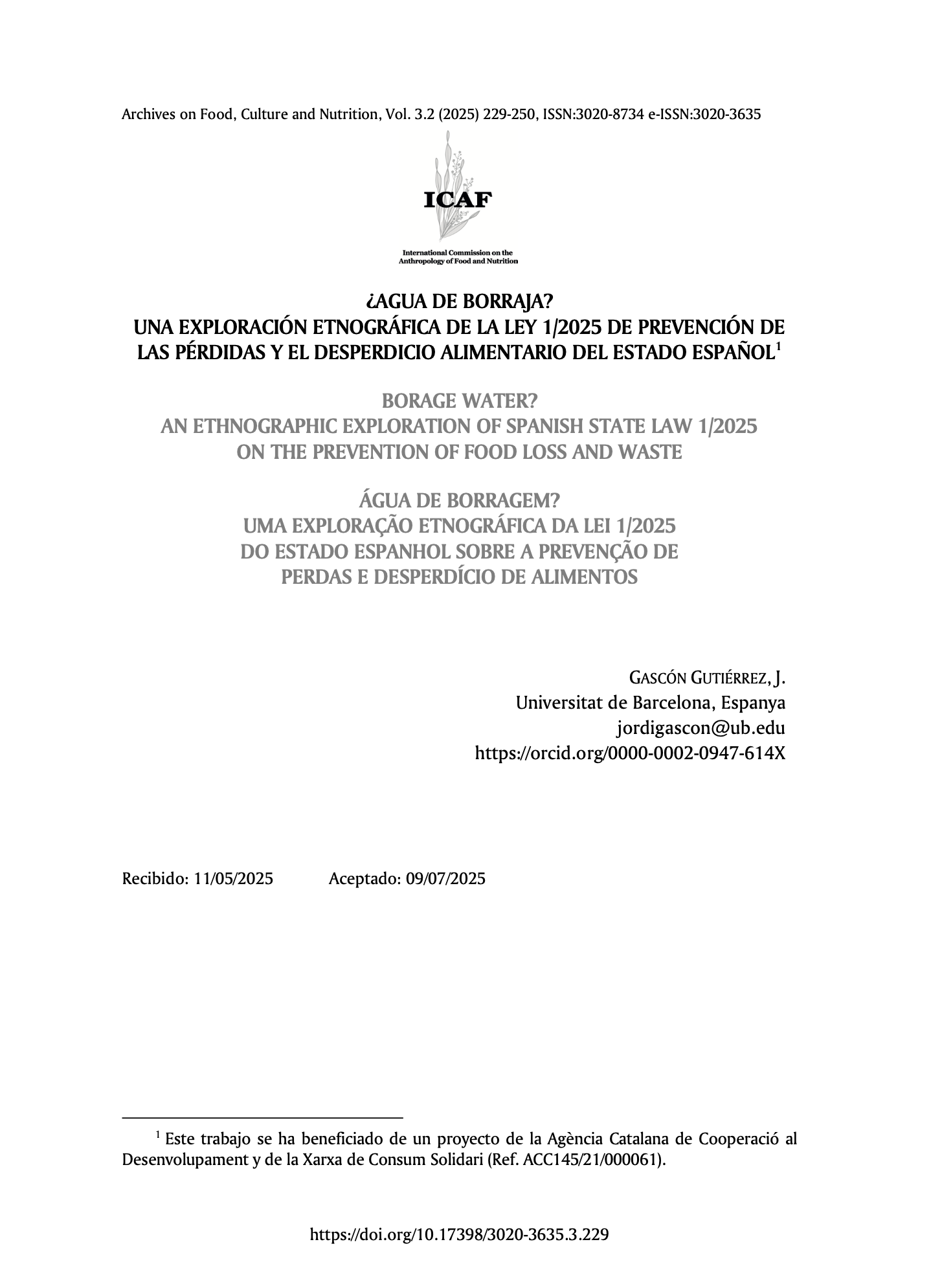
Borage water?
An ethnographic exploration of the Spanish Law 1/2025 on the prevention of food losses and food waste
DOI:
https://doi.org/10.17398/320-365.3.229Keywords:
Food waste, Legislation, Agri-food chain, Power relations, Lleida (Catalonia, Spain)Abstract
In April 2025, Spain's Official State Gazette (BOE) published Law 1/2025 on the prevention of food losses and food waste. Its aim is to reduce this phenomenon which, according to FAO data, accounts for the loss of a third of global food production. The Law identifies two elements as causes of food waste: technical and logistical shortcomings in the agri-food chain, and a cultural loss of perception of the value of food. This article asks whether the Law is not avoiding other factors that may have a substantial effect on the phenomenon. To this end, it presents the results of an ethnographic research carried out in the province of Lleida (Catalonia, Spain) between 2017 and 2022. This ethnography reveals that the main reason for food waste is to be found in the unequal relationships between the actors in the agri-food chain. The hegemonic role of some of them (exporters and supermarket chains) allows them to increase their profits at the expense of imposing on the rest (farmers, cooperatives) certain conditions that generate food waste. It is concluded that Law 1/2025 does not identify the roots of the problem it seeks to address, as it does not consider the power relations that characterize the agri-food chain, and that this calls into question its effectiveness.
References
Altieri, M. (1995). Agroecology: The science of sustainable agriculture. Westview Press.
Arias, C. & Ellen, H. M. (2018). Reducing post-harvest food losses through innovative collaboration: Insights from the Colombian and Mexican avocado supply chains. Journal of Cleaner Production, 199, 1020-1034. https://doi.org/10.1016/j.jclepro.2018.06.187
Artiuch, P. & Kornstein, S. (2012). Sustainable Approaches to Reducing Food Waste in India. Massachusetts Institute of Technology.
Aschemann-Witzel, J. (2018). Helping You to Waste Less? Consumer Acceptance of Food Marketing Offers Targeted to Food-Related Lifestyle Segments of Consumers. Journal of Food Products Marketing, 24(5), 522–538. https://doi.org/10.1080/10454446.2018.1472693
Baraja, E.; Herrero, D. &Martínez, M. (2021). Política Agraria Común y despoblación en los territorios de la España interior (Castilla y León). AGER, Revista de estudios sobre despoblación y desarrollo rural, 33, 151-182. https://doi.org/10.4422/ager.2021.16
Beale, C. L. (1964). Rural depopulation in the United States: Some demographic consequences of agricultural adjustments. Demography, 1, 264–272. https://doi.org/10.1007/BF03208467
Bernard, H. R. (2017). Research methods in anthropology. Rowman & Littlefield.
Binimelis, R.; Escurriol, V. &Rivera-Ferre, M. G. (2012). Soberanía Alimentaria. Transformación Artesanal y Género. Mundubat.
Bowman, M. (2020). Challenging hegemonic conceptions of food waste: Critical reflections from a food waste activist. En C. Reynolds, T. Soma, C. Spring & J. Lazell (Eds.), Routledge Handbook of Food Waste. Routledge. https://doi.org/10.4324/9780429462795
Bretón, V. (2000). Tierra, Estado y Capitalismo: La transformación agraria del Occidente catalán, 1940-1990. Milenio.
Bretón, V. (2009). ¿Continuarán muriendo de hambre millones de personas en el siglo XXI? Revista Española de Estudios Agrosociales y Pesqueros, 224, 69-109.
Coordinadora de Organizaciones de Agricultores y Ganaderos [COAG]. (2025). IPOD: Histórico mes a mes. https://chil.me/download-file/d3b52b95-91e7-4d1b-935c-ab87030ec822
Corradini, M. G. (2018). Shelf life of food products: From open labeling to real-time measurements. Annual review of food science and technology, 9, 251-269. https://doi.org/10.1146/annurev-food-030117-012433
Departament d'Agricultura, Ramaderia, Pesca i Alimentació [DARP]. (2023). Estadístiques definitives de conreus: Superfícies, rendiments i produccions provincials dels conreus agrícoles. https://agricultura.gencat.cat/web/.content/de_departament/de02_estadistiques_observatoris/02_estructura_i_produccio/02_estadistiques_agricoles/01_llencols_definitius/fitxers_estatics/produccions_catalunya/Llencols_Catalunya_2023.pdf
Devin, B. & Richards. C. (2018). Food waste, power, and corporate social responsibility in the Australian food supply chain. Journal of Business Ethics, 150(1), 199-210. https://doi.org/10.1007/s10551-016-3181-z
Food and Agriculture Organization of the United Nations [FAO]. (2014). Definitional framework of food loss [Documento de trabajo]. FAO.
Farré, M. & Sala. M. (2014). Estrategias empresariales de la gran distribución de fruta fresca en España: Cambios y tendencias. Anales de Economía Aplicada, 28, 1410-1425. http://hdl.handle.net/10459.1/64848
Foucault, M. (2022/1970). El orden del discurso. Barcelona: Austral.
Gascón, J. (2018). Food waste: A political ecology approach. Journal of Political Ecology, 25(1), 587-601. https://doi.org/10.2458/v25i1.23119
Gascón, J. (2025) In whose favor does the cooperative work? Power structure in the agrifood chain in Lleida (Catalonia, Spain). En S. Narotzky, N. Buier & T. Vetta (Eds.), Agricultural extractivism in the Mediterranean region: A socioecological view. Palgrave.
Gascón, J.; Solà, C. & Larrea-Killinger, C. (2021). “No es negociable con ellos”: Desperdicio alimentario y relaciones de poder en la cadena agroalimentaria. Icaria.
Gascón, J.; Solà, C. & Larrea-Killinger, C. (2022). A qualitative approach to food loss. The case of the production of fruit in Lleida (Catalonia, Spain). Agroecology and Sustainable Food Systems, 46(5), 736-757. https://doi.org/10.1080/21683565.2022.2061099
Gascón, J.; Larrea-Killinger, C. & Solà, C. (2023). Food waste and power relations in the agri-food chain: The Fruit Sector in Lleida (Catalonia, Spain). Journal of Agricultural and Environmental Ethics, 36(2), 13. https://doi.org/10.1007/s10806-023-09908-8
Gorenstein, S. (1998). Sector agroalimentario: Las relaciones industria/gran distribución. Desarrollo Económico, 38(149), 457-476. https://doi.org/10.2307/3467388
Gustavsson, J., Cederberg, C. & Sonesson, U. (2011). Global food losses and food waste. FAO.
Iglesias, I. & Casals, E. (2011). Producción, comercialización y consumo de melocotón en España. Vida Rural, 323, 27-34.
Hall, K. D., Guo, J., Dore, M. & Chow, C. C. (2009). The progressive increase of food waste in America and its environmental impact. PloS one, 4(11), e7940. https://doi.org/10.1371/journal.pone.0007940
Hepp, C. (2020). Food waste or surplus? Reading between the lines of discourse and action. En A. Nelson & E. Ferne (Eds.), Food for Degrowth: Perspectives and Practices (pp. 186-197). Routledge.
Hoehn, D., Vázquez-Rowe, I., Kahhat, R., Margallo, M., Laso, J., Fernández-Ríos, A., Ruiz-Salmón, I. & Aldaco, R. (2023). A critical review on food loss and waste quantification approaches: Is there a need to develop alternatives beyond the currently widespread pathways? Resources, Conservation and Recycling, 188, 106671. https://doi.org/10.1016/j.resconrec.2022.106671
Isakson, S. R. 2014. “Food and finance: The financial transformation of agro-food supply chains.” The Journal of Peasant Studies, 41(5), 749-775. https://doi.org/10.1080/03066150.2013.874340
Kling, W. (1943). Food Waste in Distribution and Use. American Journal of Agricultural Economics, 25(4), 848-859.
Lanfranchi, M.; Giannetto. C. & de Pascale, A. (2014). Analysis and models for the reduction of food waste in organized large-scale retail distribution in eastern Sicily. American Journal of Applied Sciences, 11(10), 1860. https://doi.org/10.3844/ajassp.2014.1860.1874Ley 1/2025, de 1 de abril, de prevención de las pérdidas y el desperdicio alimentario. Boletín Oficial del Estado, 79, de 2 de abril de 2025. https://www.boe.es/buscar/act.php?id=BOE-A-2025-6597
Ley 17/2011, de 5 de julio, de seguridad alimentaria y nutrición. Boletín Oficial del Estado, 160, de 6 de julio de 2011. https://www.boe.es/buscar/act.php?id=BOE-A-2011-11604
Llei 3/2020, de 11 de març, de prevenció de les pèrdues i el malbaratament alimentaris. Diari Oficial de la Generalitat de Catalunya, 8082, de 13 de març de 2020. https://dogc.gencat.cat/ca/document-del-dogc/?documentId=870633
Lundqvist, J.; De Fraiture, C. & Molden, D. (2008). Saving Water: From Field to Fork: Curbing Losses and Wastage in the Food Chain (SIWI Policy Brief) Stockholm: SIWI.
Martínez-Alier, J. (2021). El ecologismo de los pobres: Conflictos ambientales y lenguajes de valoración. Icaria.
McMichael, P. (2009). A food regime genealogy. The Journal of Peasant Studies, 36(1), 139-169. https://doi.org/10.1080/03066150902820354
McMichael, P. (2013). Food Regimes and Agrarian Questions. Fernwood.
Montagut, X. & Dogliotti, F. (2006). Alimentos globalizados. Icaria.
Montagut, X. & Gascón, J. (2014). Alimentos desperdiciados: Un análisis del derroche alimentario desde la soberanía alimentaria. Icaria.
Muriana, C. (2017). A focus on the state of the art of food waste/losses issue and suggestions for future researches. Waste Management, 68, 557-570. https://doi.org/10.1016/j.wasman.2017.06.047
Observatori de la fruita. (2019). Informe anual 2019. Barcelona: DARP - Generalitat de Catalunya.
Östergren, K.. Bos-Brouwers, H., Timmermans, T., Hansen, O. J., Møller. H., Anderson. G., O’Connor. C., Soethoudt, H., Quested. T. & Easteal, S. (2014). FUSIONS Definitional Framework for Food Waste: Full Report. SIK & UE Fusions.
Parfitt, J.; Barthel, M. & Macnaughton, S. (2010). Food waste within food supply chains: Quantification and potential for change to 2050. Philosophical transactions of the royal society B: Biological sciences, 365(1554), 3065-3081. https://doi.org/10.1098/rstb.2010.0126
Parlamento Europeo. (2017, 16 de mayo). Resolución sobre la iniciativa sobre el uso eficiente de los recursos: reducir el desperdicio de alimentos, mejorar la Seguridad alimentaria (2016/2223-INI). https://www.europarl.europa.eu/doceo/document/TA-8-2017-0207_ES.html
Patnaik, U. (2008). The Republic of Hunger and Other Essays. Merlin Press.
Pimentel, D. & Lehman, H. (Eds.) (1993). The Pesticide Question: Environment, Economics and Ethics. Springer.
Priefer, C.; Jörissen, J. & Bräutigam, K. R. (2016). Food waste prevention in Europe–A cause-driven approach to identify the most relevant leverage points for action. Resources, Conservation and Recycling, 109, 155-165. https://doi.org/10.1016/j.resconrec.2016.03.004
Prieto, M., Mouwen, J. M., López Puente, S. & Cerdeño Sánchez, A. (2008). Concepto de calidad en la industria agroalimentaria. Interciencia, 33(4), 258-264.
Raak, N., Symmank, C., Zahn, S., Aschemann-Witzel, J. & Rohm, H. (2017). Processing-and product-related causes for food waste and implications for the food supply chain. Waste management, 61, 461-472. https://doi.org/10.1016/j.wasman.2016.12.027
Robles, B. (2011). "La entrevista en profundidad: Una técnica útil dentro del campo antropofísico." Cuicuilco, 18(52), 39-49.
Shiva, V. (2016). The Violence of the Green Revolution: Third World Agriculture, Ecology, and Politics. University Press of Kentucky.
Stuart, T. 2009. Waste: Uncovering the Global Food Scandal. Penguin.
Thompson, P- B. (2017). The Spirit of the Soil: Agriculture and Environmental Ethics. Routledge.
Wu, Z.; Mohammed, A. & Harris, I. (2021). Food waste management in the catering industry: Enablers and interrelationships. Industrial Marketing Management, 94, 1-18. https://doi.org/10.1016/j.indmarman.2021.01.019
Published
Issue
Section
License
Copyright (c) 2025 Jordi Gascón Gutiérrez

This work is licensed under a Creative Commons Attribution 4.0 International License.
Journal editors must be attentive to intellectual property issues and work together with their editor to manage potential infringements of intellectual property laws and conventions. It is important to note that the intellectual property laws of the local jurisdiction are sovereign.
All content published in Archives in Food, Culture and Nutrition (AFOCUN) is under a Creative Commons Attribution 4.0 International License (CC BY 4.0) for open access. This license allows others to distribute, remix, adapt, and build upon the work, even for commercial purposes, as long as appropriate credit is given to the original author. Authors retain copyright and grant the journal the right of first publication, registering the work under the corresponding attribution license. This allows third parties to use the published content as long as the authorship of the work and the original publication in this journal are acknowledged.
For more information about the license terms, see the official link: Creative Commons Attribution 4.0 International License.
Archives in Food, Culture and Nutrition respects the intellectual and proprietary rights (copyright) of published works and allows authors to freely use their own published works, always within the limits of applicable law