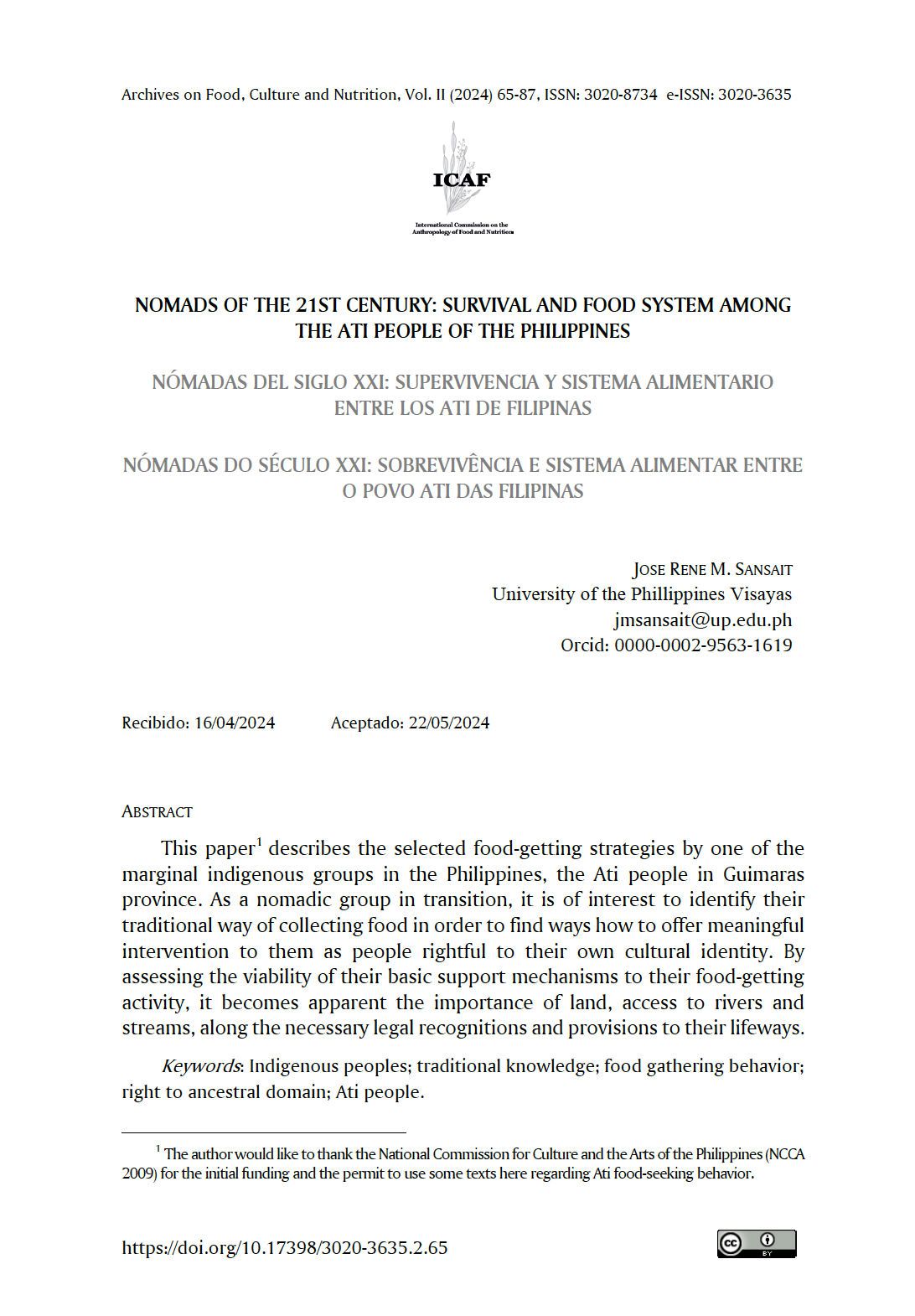
Nomads of the 21st century
Survival and food system among the Ati people of the Philippines
DOI:
https://doi.org/10.17398/3020-3635.2.65Keywords:
Indigenous peoples, traditional knowledge, food gathering behavior, right to ancestral domain, Ati peopleAbstract
This paper describes the selected food-getting strategies by one of the marginal indigenous groups in the Philippines, the Ati people in Guimaras province. As a nomadic group in transition, it is of interest to identify their traditional way of collecting food in order to find ways how to offer meaningful intervention to them as people rightful to their own cultural identity. By assessing the viability of their basic support mechanisms to their food-getting activity, it becomes apparent the importance of land, access to rivers and streams, along the necessary legal recognitions and provisions to their lifeways.
Downloads
Published
Issue
Section
License
Journal editors must be attentive to intellectual property issues and work together with their editor to manage potential infringements of intellectual property laws and conventions. It is important to note that the intellectual property laws of the local jurisdiction are sovereign.
All content published in Archives in Food, Culture and Nutrition (AFOCUN) is under a Creative Commons Attribution 4.0 International License (CC BY 4.0) for open access. This license allows others to distribute, remix, adapt, and build upon the work, even for commercial purposes, as long as appropriate credit is given to the original author. Authors retain copyright and grant the journal the right of first publication, registering the work under the corresponding attribution license. This allows third parties to use the published content as long as the authorship of the work and the original publication in this journal are acknowledged.
For more information about the license terms, see the official link: Creative Commons Attribution 4.0 International License.
Archives in Food, Culture and Nutrition respects the intellectual and proprietary rights (copyright) of published works and allows authors to freely use their own published works, always within the limits of applicable law