
"Popular" gastronomy in the era of "global" taste
DOI:
https://doi.org/10.17398/3020-3635.1.25Keywords:
Food, culture, gatronomy, territory, heritageAbstract
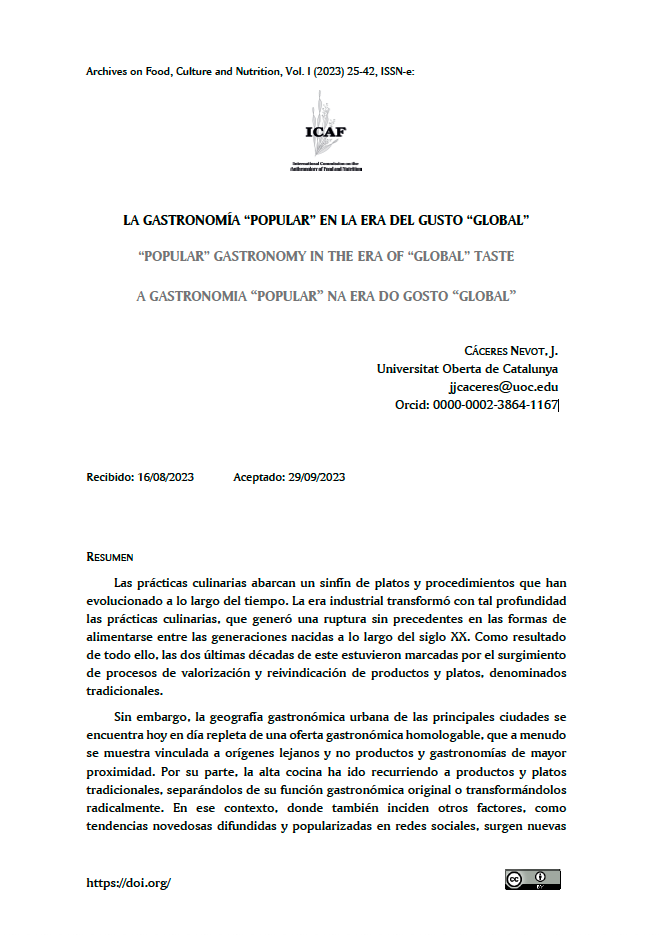
Culinary practices encompass an endless number of dishes and procedures that have evolved over time. The industrial era transformed culinary practices so profoundly that it generated an unprecedented break in the ways of eating among the generations born throughout the 20th century. Hence, the last two decades of the same were already strongly marked by the processes of valorisation and claim of products and dishes, called traditional.
With the entry into the new millennium, the appreciation of traditional cuisines has faced new challenges. The urban gastronomic geography that populates the main cities is today full of a comparable offer linked to different origins, be it Japanese, Italian, Indian, etc. For its part, haute cuisine has been resorting to traditional products and dishes, separating them from their original gastronomic function or radically transforming them. In this context, where other factors also have an impact, such as novel trends disseminated and popularized on social networks, new unknowns arise about the future of what has been called traditional gastronomy and its ability to occupy a real and recognizable place among the gastronomic offer.
Published
Versions
- 2023-11-25 (3)
- 2023-11-25 (2)
- 2023-11-06 (1)
Issue
Section
License
Journal editors must be attentive to intellectual property issues and work together with their editor to manage potential infringements of intellectual property laws and conventions. It is important to note that the intellectual property laws of the local jurisdiction are sovereign.
All content published in Archives in Food, Culture and Nutrition (AFOCUN) is under a Creative Commons Attribution 4.0 International License (CC BY 4.0) for open access. This license allows others to distribute, remix, adapt, and build upon the work, even for commercial purposes, as long as appropriate credit is given to the original author. Authors retain copyright and grant the journal the right of first publication, registering the work under the corresponding attribution license. This allows third parties to use the published content as long as the authorship of the work and the original publication in this journal are acknowledged.
For more information about the license terms, see the official link: Creative Commons Attribution 4.0 International License.
Archives in Food, Culture and Nutrition respects the intellectual and proprietary rights (copyright) of published works and allows authors to freely use their own published works, always within the limits of applicable law