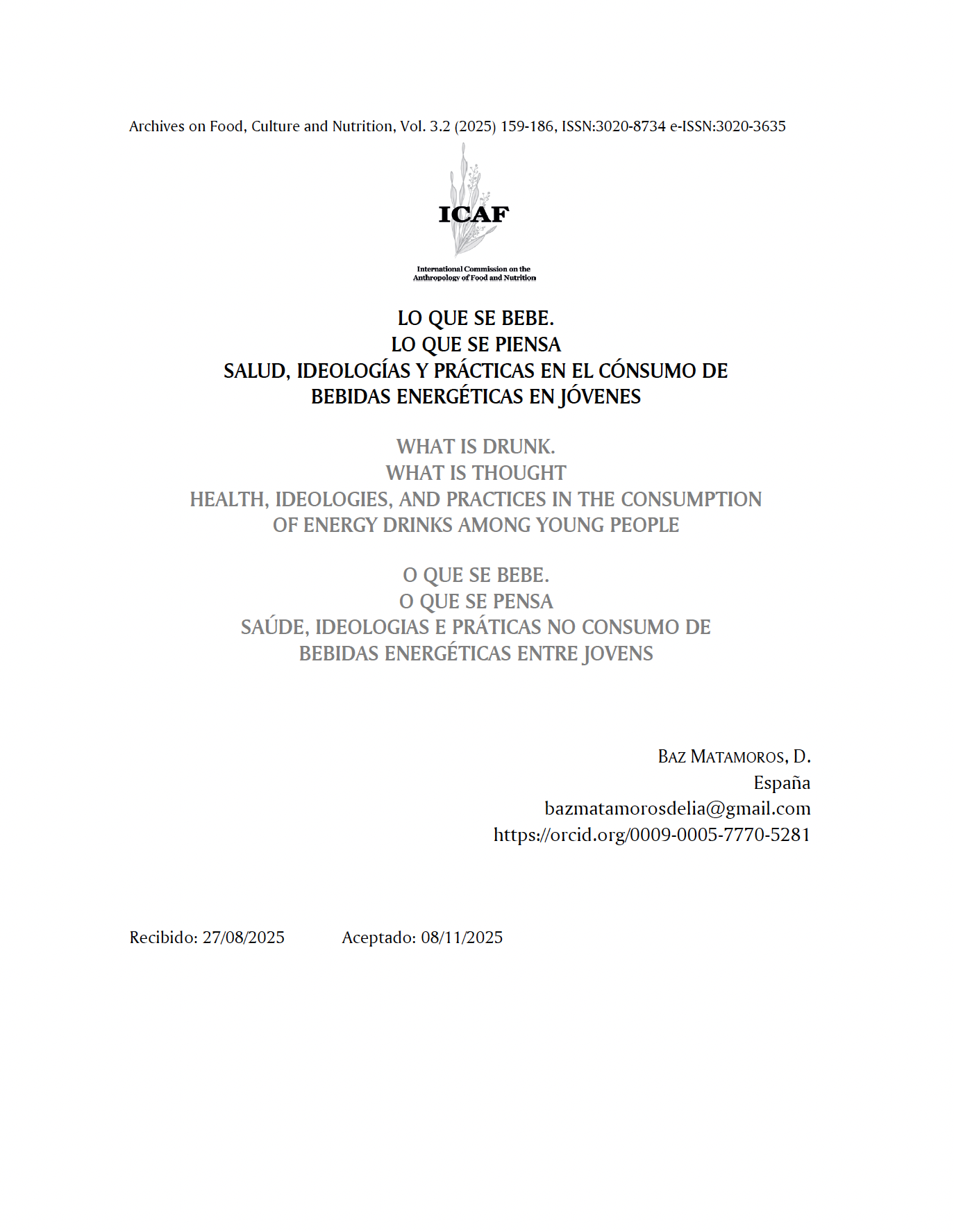
O que se bebe; o que se pensa
Saúde, ideologias e práticas no consumo de bebidas energéticas entre jovens
DOI:
https://doi.org/10.17398/320-365.3.159Palavras-chave:
Bebidas energéticas; jóvenes; motivaciones; práctica deportiva; salud pública.Resumo
Introdução: O consumo de bebidas energéticas aumentou de forma significativa entre a população jovem, gerando preocupação quanto aos seus possíveis efeitos sobre a saúde e à perceção social da sua inocuidade.
Objetivos: O estudo aqui apresentado investiga as ideologias e representações que motivam o consumo de bebidas energéticas (BE) entre jovens, avaliando possíveis apreciações erróneas e/ou a falta de ação efetiva por parte dos agentes de saúde.
Método: Investigação de caráter misto, qualitativo e quantitativo. A análise quantitativa utilizou a escala CaffEQ em 246 participantes espanhóis (14–30 anos, desportistas e não desportistas), através de uma amostragem intencional. Do ponto de vista qualitativo, realizaram-se entrevistas semiestruturadas a 14 participantes, explorando ideologias e motivações de consumo, o que torna este estudo pioneiro no contexto espanhol.
Resultados: Os resultados evidenciam um baixo reconhecimento do possível risco de dependência, apesar da presença de desejos frequentes e de experiências subjetivas de necessidade de consumo. 96% dos participantes não se considera dependente. No entanto, a análise qualitativa revela uma tendência para minimizar esse risco. Em termos emocionais e sociais, embora a maioria não percecione efeitos positivos significativos, 37% reconhece melhorias ocasionais do estado de ânimo. Os relatos complementam e aprofundam estes achados, sugerindo uma relação complexa entre perceção, hábito de consumo e riscos subvalorizados.
Conclusões: Destaca-se a necessidade de reforçar a educação em saúde entre os jovens sobre os riscos do consumo de bebidas energéticas, bem como de envolver ativamente os profissionais de saúde na sua prevenção. Propõe-se regular o patrocínio desportivo por parte desta indústria e fomentar a investigação para compreender melhor as suas causas e efeitos.
Referências
Alhumud, M., Moore, S., & Morgan, K. (2020). Energy Drink Mechanisms of Harm in Young People and Adolescents: A Narrative Review. Journal of Food and Nutrition Research. https://doi.org/10.12691/JFNR-8-1-5
Aonso-Diego, G., Krotter, A., & García-Pérez, Á. (2024). Prevalence of energy drink consumption world-wide: A systematic review and meta-analysis. Addiction, 119(3), 438-463. https://doi.org/10.1111/add.16390
Armendariz, C. R., Hurtado, M. M. C., Pons, R. M. G., Muñoz, M. J. G., García, E. L., Navas, F. J. M., & Baquedano, M. P. P. (2021). Informe del Comité Científico de la Agencia Española de Seguridad Alimentaria y Nutrición (AESAN) sobre los riesgos asociados al consumo de bebidas energéticas. (33; pp. 151-210). Revista del Comité Científico de la AESAN.
Attipoe, S., Leggit, J., & Deuster, P. A. (2016). Caffeine Content in Popular Energy Drinks and Energy Shots. Military Medicine, 181(9), 1016-1020. https://doi.org/10.7205/MILMED-D-15-00459
Azarm, V., Link, J.-P., Mandilaras, G., Li, P., Dalla-Pozza, R., Jakob, A., Haas, N. A., Oberhoffer, F. S., & Schrader, M. (2024). Acute Cardiovascular Effects of Simultaneous Energy Drink and Alcohol Consumption in Young Adults: A Review of Case Reports. Pediatric Reports, 16(3), 618-630. https://doi.org/10.3390/pediatric16030052
Belzunegui-Eraso, Angel, & et al. (2020). Substance use among Spanish adolescents: The information paradox. International Journal of Environmental Research and Public Health, 17(2), 627. https://doi.org/10.3390/ijerph17020627
Bleakley, Amy, & et al. (2022). A content analysis of sports and energy drink advertising. Appetite, 174, 106010. https://doi.org/10.1016/j.appet.2022.106010
Bonar, E. E., Cunningham, R. M., Polshkova, S., Chermack, S. T., Blow, F. C., & Walton, M. A. (2015). Alcohol and energy drink use among adolescents seeking emergency department care. Addictive Behaviors, 43, 11-17. https://doi.org/10.1016/j.addbeh.2014.11.023
Blankson, K. L., Thompson, A. M., Ahrendt, D. M., & Patrick, V. (2013). Energy drinks: What teenagers (and their doctors) should know. Pediatrics in Review, 34(2), 55-62. https://doi.org/10.1542/pir.34-2-55
Breda, J. J., Whiting, S. H., Encarnação, R., Norberg, S., Jones, R., Reinap, M., & Jewell, J. (2014). Energy Drink Consumption in Europe: A Review of the Risks, Adverse Health Effects, and Policy Options to Respond. Frontiers in Public Health, 2. https://doi.org/10.3389/fpubh.2014.00134
Busuttil, M., & Willoughby, S. (2016). A survey of energy drink consumption among young patients presenting to the emergency department with the symptom of palpitations. International Journal of Cardiology, 204, 55-56. https://doi.org/10.1016/j.ijcard.2015.11.118
Cadoni, C., & Peana, A. T. (2023). Energy drinks at adolescence: Awareness or unawareness? Frontiers in Behavioral Neuroscience, 17, 1080963. https://doi.org/10.3389/fnbeh.2023.1080963
Cala Ramos, A., Fernández, B., & Ortiz, C. (2023). Impacto de las bebidas energéticas en el sueño y el estrés en jóvenes consumidores. Sleep Medicine Reviews, 59, 101–109. https://doi.org/10.1016/j.smrv.2022.101391
Capacci, S., Allais, O., Bonnet, C., & Mazzocchi, M. (2019). The impact of the French soda tax on prices and purchases. An ex post evaluation. PloS one, 14(10), e0223196. https://doi.org/10.1371/journal.pone.0223196
Chatterjee, A. & Abraham, J. (2019). A comprehensive study on sports and energy drinks. In Sports and energy drinks. Woodhead Publishing., 515-537. https://doi.org/10.1016/B978-0-12-815851-7.00015-2
Chen, Xuan, & et al. (2019). New concerns on caffeine consumption and the impact of potential regulations: The case of energy drinks. Food policy, 87, 101746. https://doi.org/10.1016/j.foodpol.2019.101746
Cooper Jr, Robert K., & et al. (2021). Caffeine enhances sustained attention among adolescents. Experimental and clinical psychopharmacology, 29(1), 82. https://doi.org/10.1037/pha0000364
Costa, B. M., Hayley, A., & Miller, P. (2014). Young adolescents’ perceptions, patterns, and contexts of energy drink use. A focus group study. Appetite, 80, 183-189. https://doi.org/10.1016/j.appet.2014.05.013
Costa, L. & Rodríguez, M. (2020). Políticas públicas y regulación de bebidas energéticas en la Unión Europea. Policy Studies, 37(4), 475-489.
Cotter, B. V., Jackson, D. A. E., Merchant, R. C., Babu, K. M., Baird, J. R., Nirenberg, T., & Linakis, J. G. (2013). Energy Drink and Other Substance Use Among Adolescent and Young Adult Emergency Department Patients: Pediatric Emergency Care, 29(10), 1091-1097. https://doi.org/10.1097/PEC.0b013e3182a6403d
Danesi, M. (2016). A note on the meanings of junk food. Semiotica, 2016(211), 127-137. https://doi.org/10.1515/sem-2016-0094
Del Coso, J., Muñoz-Fernández, V. E., Muñoz, G., Fernández-Elías, V. E., Ortega, J. F., Hamouti, N., Barbero, J. C., & Muñoz-Guerra, J. (2012). Effects of a caffeine-containing energy drink on simulated soccer performance. PloS One, 7(2), e31380. https://doi.org/10.1371/journal.pone.0031380
World Health Organization. (2020). Directrices de la OMS Sobre Actividad Física y Hábitos Sedentarios: De un Vistazo (1st ed).
Dulloo, A. G., Geissler, C. A., Horton, T., Collins, A., & Miller, D. S. (1989). Normal caffeine consumption: Influence on thermogenesis and daily energy expenditure in lean and postobese human volunteers. The American Journal of Clinical Nutrition, 49(1), 44-50. https://doi.org/10.1093/ajcn/49.1.44
EDADES. (2024). Encuesta sobre Alcohol y Drogas en España, 1995-2024. Disponible en: https://pnsd.sanidad.gob.es/profesionales/sistemasInformacion/sistemaInformacion/pdf/2024_Informe_EDADES.pdf
Ehlers, A., Marakis, G., Lampen, A., & Hirsch-Ernst, K. I. (2019). Risk assessment of energy drinks with focus on cardiovascular parameters and energy drink consumption in Europe. Food and Chemical Toxicology, 130, 109-121. https://doi.org/10.1016/j.fct.2019.05.028
ESTUDES. (2023). Informe bebidas energéticas. Disponible en: https://pnsd.sanidad.gob.es/ciudadanos/dosieresinformacion/pdf/20231204_OEDA_BebidasEnergeticasESTUDES2023_.pdf
García, M. & Gómez, L. (2018). Conocimientos de estudiantes de medicina sobre bebidas energéticas y sus riesgos. Educación Médica, 22(3), 211-218. https://doi.org/10.1016/j.edumed.2018.05.001
Geertz, C. (2000). La interpretación de las culturas (Vol. 1). Gedisa.
Goldstein, E., Ziegenfuss, T., Kalman, D., Kreider, R., Campbell, B., Wilborn, C., & Antonio, J. (2016). International society of sports nutrition position stand: Caffeine and performance. Journal of the International Society of Sports Nutrition. 13(1), 54. https://doi.org/10.1186/1550-2783-7-5
González, R. (2024). El impacto de las bebidas energéticas en el ámbito social: Percepciones y realidades. Revista de Psicología Social, 29(2), 125-138. https://doi.org/10.1016/j.rpsp.2023.03.004
Hammond, D., & Reid, J. L. (2018). Exposure and perceptions of marketing for caffeinated energy drinks among young Canadians. Public Health Nutrition, 21(3), 535-542. https://doi.org/10.1017/S1368980017002890
Huffington Post. (2024). La imagen de energía: Cómo el marketing moldea el consumo de bebidas energéticas. Disponible en: https://www.huffpost.com/energia
Huntley, E. D., & Juliano, L. M. (2012). Caffeine Expectancy Questionnaire (CaffEQ): Construction, psychometric properties, and associations with caffeine use, caffeine dependence, and other related variables. Psychological Assessment, 24(3), 592-607. https://doi.org/10.1037/a0026417
Jacobson, B. H., Hester, G. M., Palmer, T. B., Williams, K., Pope, Z. K., Sellers, J. H., Conchola, E. C., Woolsey, C., & Estrada, C. (2018). Effect of Energy Drink Consumption on Power and Velocity of Selected Sport Performance Activities. Journal of Strength and Conditioning Research, 32(6), 1613-1618. https://doi.org/10.1519/JSC.0000000000002026
Jagim, A. R., Harty, P. S., Barakat, A. R., Erickson, J. L., Carvalho, V., Khurelbaatar, C., Camic, C. L., & Kerksick, C. M. (2022). Prevalence and Amounts of Common Ingredients Found in Energy Drinks and Shots. Nutrients, 14(2), 314. https://doi.org/10.3390/nu14020314
Juárez, C. (2020). Regulan bebidas energizantes. THE FOOD TECH - Medio de noticias líder en la Industria de Alimentos y Bebidas. Disponible en: https://thefoodtech.com/normatividad-y-certificaciones/regulan-bebidas-energizantes/
Kobik, W., & Aryee, P. A. (2024). Energy drinks in Tamale: Understanding youth perceptions, consumption patterns, and related factors. PLOS ONE, 19(4), e0289391. https://doi.org/10.1371/journal.pone.0289391
Kumar, G. S., Park, S., & Onufrak, S. (2014). Association between reported screening and counseling about energy drinks and energy drink intake among U.S. adolescents. Patient Education and Counseling, 94(2), 250-254. https://doi.org/10.1016/j.pec.2013.09.026
Kurtz, A. M., Leong, J., Anand, M., Dargush, A. E., & Shah, S. A. (2013). Effects of Caffeinated Versus Decaffeinated Energy Shots on Blood Pressure and Heart Rate in Healthy Young Volunteers. Pharmacotherapy: The Journal of Human Pharmacology and Drug Therapy, 33(8), 779-786. https://doi.org/10.1002/phar.1296
Kwon, S., Do, K. T., McCormick, E. M., & Telzer, E. H. (2021). Neural Correlates of Conflicting Social Influence on Adolescent Risk Taking. Journal of Research on Adolescence, 31(1), 139-152. https://doi.org/10.1111/jora.12587
Larson, N., DeWolfe, J., Story, M., & Neumark-Sztainer, D. (2014). Adolescent Consumption of Sports and Energy Drinks: Linkages to Higher Physical Activity, Unhealthy Beverage Patterns, Cigarette Smoking, and Screen Media Use. Journal of Nutrition Education and Behavior, 46(3), 181-187. https://doi.org/10.1016/j.jneb.2014.02.008
Leis, R. (2025). Bebidas estimulantes: Ni bebidas energéticas ni para adolescentes. Anales de Pediatría, 102(3). https://doi.org/10.1016/j.anpedi.2025.503795
Luneke, A. C., Glassman, T. J., Dake, J. A., Blavos, A. A., Thompson, A. J., & Kruse-Diehr, A. J. (2022). Energy drink expectancies among college students. Journal of American College Health, 70(4), 1195-1203. https://doi.org/10.1080/07448481.2020.1790569
Montgomery, K. & Chester, J. (2019). The role of digital marketing in shaping youth consumption of energy drinks. Public Health Nutrition. 22(16), 2909-2918.
Nadeem, I. M., Shanmugaraj, A., Sakha, S., Horner, N. S., Ayeni, O. R., & Khan, M. (2020). Energy Drinks and Their Adverse Health Effects: A Systematic Review and Meta-analysis. Sports Health, 13(3), 265-277. https://doi.org/10.1177/1941738120949181
Naveh, G., Mansour, B., Bader, M., Steckler, R., Nasrallah, E., Hujeyrat, H., Magzal, F., Elias, N., Horovitz, O., & Nimri, L. (2024). Physiological Impacts of Energy Drink Consumption: A Clinical Analysis in Adolescents. Nutrients, 16(14), 2328. https://doi.org/10.3390/nu16142328
Nowak, D., & Jasionowski, A. (2016). Analysis of Consumption of Energy Drinks by a Group of Adolescent Athletes. International Journal of Environmental Research and Public Health, 13(8), 768. https://doi.org/10.3390/ijerph13080768
Nowell, L. S., Norris, J. M., White, D. E., & Moules, N. J. (2017). Thematic Analysis: Striving to Meet the Trustworthiness Criteria. International Journal of Qualitative Methods, 16(1), 1609406917733847. https://doi.org/10.1177/1609406917733847
O’Brien, M. C., McCoy, T. P., Rhodes, S. D., Wagoner, A., & Wolfson, M. (2008). Caffeinated cocktails: Energy drink consumption, high-risk drinking, and alcohol-related consequences among college students. Academic Emergency Medicine: Official Journal of the Society for Academic Emergency Medicine, 15(5), 453-460. https://doi.org/10.1111/j.1553-2712.2008.00085.x
Onda Cero. (2025,). Galicia prohíbe las bebidas energéticas y vapeadores a menores: Habrá sanciones a los que lo incumplan. Disponible en: https://www.ondacero.es/noticias/sociedad/galicia-prohibe-bebidas-energeticas-vapeadores-menores-habra-sanciones-que-incumplan_202507296888fd6babb2960d1fb9194c.html
Pereira, J. C., Silva, R. G., Fernandes, A. de A., Quintana, M. S., & Marins, J. C. B. (2015). ¿Tienen las bebidas energéticas efectos ergogénicos en el ejercicio físico? 32(168), 231-238. ISSN (0212-8799)
Pfender, Emily, & et al. (2023). Perceptions of sports and energy drinks: Factors associated with adolescent beliefs. American Journal of Health Promotion, 37(1), 84-88. https://doi.org/10.1177/08901171221113521
Pintor Holguín, E., Rubio Alonso, M., Grille Álvarez, C., Álvarez Quesada, C., Ruiz-Valdepeñas, B. H. (2020). Prevalencia del consumo de bebidas energéticas, motivación y factores asociados en alumnos de Medicina: Estudio transversal. Revista Española de Nutrición Humana y Dietética, 24(1), 61-67. https://doi.org/10.14306/renhyd.24.1.796
Polak, K., Dillon, P., Koch, J. R., Miller, W. G., Thacker, L., & Svikis, D. (2016). Energy drink use is associated with alcohol and substance use in eighth, tenth, and twelfth graders. Preventive Medicine Reports, 4, 381-384. https://doi.org/10.1016/j.pmedr.2016.06.019
Pommerening, M. J., Cardenas, J. C., Radwan, Z. A., Wade, C. E., Holcomb, J. B., & Cotton, B. A. (2015). Hypercoagulability after energy drink consumption. Journal of Surgical Research, 199(2), 635-640. https://doi.org/10.1016/j.jss.2015.06.027
Poncela, N. (2025). Asturias prohibirá las bebidas energéticas a menores de 16 años mediante una ley autonómica. El País. Disponible: https://elpais.com/espana/2025-03-04/asturias-prohibira-las-bebidas-energeticas-a-menores-de-16-anos-mediante-una-ley-autonomica.html
Protano, C., Valeriani, F., De Giorgi, A., Marotta, D., Ubaldi, F., Napoli, C., Liguori, G., Romano Spica, V., Vitali, M., & Gallè, F. (2023). Consumption patterns of energy drinks in university students: A systematic review and meta-analysis. Nutrition (Burbank, Los Angeles County, Calif.), 107, 111904. https://doi.org/10.1016/j.nut.2022.111904
Reissig, C. J., Strain, E. C., & Griffiths, R. R. (2009). Caffeinated energy drinks—A growing problem. Drug and Alcohol Dependence, 99(1-3), 1-10. https://doi.org/10.1016/j.drugalcdep.2008.08.001
Reith & Gerda. (2018). Addictive consumption: Capitalism, modernity and excess. Routledge.
Reith & Gerda. (2022). Intoxicating consumption: Capitalism and the commodification of pleasure. Routledge handbook of intoxicants and intoxication. Routledge, 89-100. https://doi.org/10.4324/9780429058141-8
Robertson & Roland. (1995). Glocalization: Time-space and homogeneity-heterogeneity." Global modernities. 2.1, 25-44.
Rush, E., Schulz, S., Obolonkin, V., Simmons, D., & Plank, L. (2006). Are energy drinks contributing to the obesity epidemic?. Asia Pacific journal of clinical nutrition, 15(2), 242–244. Disponible en: https://pubmed.ncbi.nlm.nih.gov/16672210/
Sánchez-Sánchez, E., Trujillo-Garrido, N., Díaz-Jimenez, J., García-García, A., Rosety, M. A., Bandez, M., Rosety-Rodriguez, M., Ordonez, F. J., Rosety, I., Diaz, A. J., (2025). Attitudes and consumption habits of energy drinks among adolescents and young adults in a Spanish population. AIMS Public Health, 12(1), Article publichealth-12-01-002. https://doi.org/10.3934/publichealth.2025002
Scholosser E. (2012). Fast food nation: The dark side of the all-American meal. Houghton Mifflin Harcourt.
-Schröder, H., Cruz Muñoz, V., Urquizu Rovira, M., Valls Ibañez, V., Manresa Domínguez, J.-M., Ruiz Blanco, G., Urquizu Rovira, M., & Toran Monserrat, P. (2021). Determinants of the Consumption of Regular Soda, Sport, and Energy Beverages in Spanish Adolescents. Nutrients, 13(6), 1858. https://doi.org/10.3390/nu13061858
Smith A. (2011). Fast Food and Junk Food (pp. 1-908). https://doi.org/10.5040/9798216968009
Strauss, A & Corbin, J. (1994). Grounded theory methodology: An overview.
Tarragon, E. (2023). Alcohol and energy drinks: Individual contribution of common ingredients on ethanol-induced behaviour. Frontiers in Behavioral Neuroscience, 17, 1057262. https://doi.org/10.3389/fnbeh.2023.1057262
Teijeiro, A., Pérez-Ríos, M., García, G., Martin-Gisbert, L., Candal-Pedreira, C., Rey-Brandariz, J., Guerra-Tort, C., Varela-Lema, L., & Mourino, N. (2025). Consumption of energy drinks among youth in Spain: Trends and characteristics. European Journal of Pediatrics, 184(6), 365. https://doi.org/10.1007/s00431-025-06177-7
Temple, J. L., Bernard, C., Lipshultz, S. E., Czachor, J. D., Westphal, J. A., & Mestre, M. A. (2017). The Safety of Ingested Caffeine: A Comprehensive Review. Frontiers in Psychiatry, 8. https://doi.org/10.3389/fpsyt.2017.00080
Thiab, S., Barakat, M., Nassar, R. I., Abutaima, R., Alsughaier, A., Thaher, R., Odeh, F., & Dayyih, W. A. (2023). Knowledge, attitude, and perception of energy drinks consumption among university students in Jordan. Journal of Nutritional Science, 12, e109. https://doi.org/10.1017/jns.2023.90
Xu, K. Y., Baumgartner, K. T., Shankar, S., Huckenpahler, A., & Glaser, P. E. (2024). Energy Drinks: A Clinical Primer and National Data Update. Missouri Medicine, 121(6), 481-488.
Yunusa, I., & Ahmad, I. M. (2011). Energy- Drinks: Composition and Health Benefits. Bayero Journal of Pure and Applied Sciences, 4(2), Article 2. https://doi.org/10.4314/bajopas.v4i2.38
Zapata, L. & Nicole Aguilera. (2018). Composición nutricional de las bebidas energéticas e isotónicas. Organización de consumidores y usuarios de Chile.
Downloads
Publicado
Edição
Secção
Licença
Direitos de Autor (c) 2025 Delia Baz Matamoros

Este trabalho encontra-se publicado com a Licença Internacional Creative Commons Atribuição 4.0.
Os editores das revistas devem estar atentos às questões de propriedade intelectual e trabalhar em conjunto com seu editor para gerir possíveis infrações das leis e convenções sobre propriedade intelectual. É importante destacar que as leis de propriedade intelectual da jurisdição local são soberanas.
Todo o conteúdo publicado em Archives in Food, Culture and Nutrition (AFOCUN) está sob uma licença Creative Commons Atribuição 4.0 Internacional (CC BY 4.0) de acesso aberto. Esta licença permite que outros distribuam, remixem, adaptem e se baseiem no trabalho, inclusive para fins comerciais, desde que seja dado o crédito adequado ao autor original. Os autores mantêm os direitos autorais e concedem à revista o direito de primeira publicação, registrando o trabalho sob a licença de atribuição correspondente. Isso permite que terceiros utilizem os conteúdos publicados, desde que a autoria do trabalho e a publicação original nesta revista sejam reconhecidas.
Para mais informações sobre os termos da licença, consulte o link oficial: Creative Commons Atribuição 4.0 Internacional.
Archives in Food, Culture and Nutrition respeita os direitos intelectuais e patrimoniais (copyright) dos trabalhos publicados e permite que os autores façam uso livre de seus próprios trabalhos publicados, sempre dentro dos limites da legislação vigente.