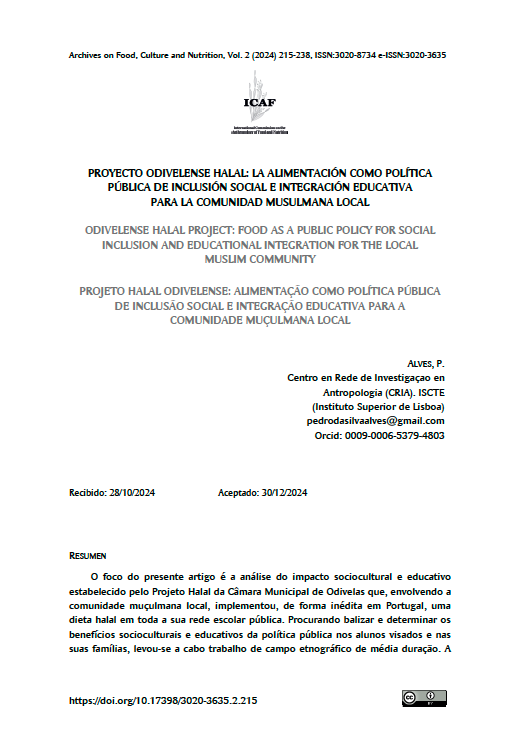
Odivelense Halal Project
Food as a public policy for social inclusion and educational integration for the local muslim community
DOI:
https://doi.org/10.17398/3020-3635.2.215Keywords:
halal, food, muslim community, inclusion, educationAbstract
The focus of this article is the analysis of the sociocultural and educational impact established by the Halal Project of the Municipality of Odivelas which, involving the local muslim community, implemented in an un precedent way, an halal diet throughout its entire public school network. Seeking to outline and determine the sociocultural and educational benefits of this public policy for the targeted students and their families, medium-term ethnographic fieldwork was carried out. The anthropological investigation of this work resulted in meetings with the Odivelas City Council, with the Halal Institute of Portugal, participatory visits to school establishments and informal interviews with the families of the students covered, as well as the owners of local halal butchers. The analytical reflection of this project proves to be relevant for the anthropological discussion on halal food in Portugal, contradicting the scarce existing disciplinary studies on it, having food as its central point to work on social, identity and religious issues.
Downloads
Published
Issue
Section
License
Journal editors must be attentive to intellectual property issues and work together with their editor to manage potential infringements of intellectual property laws and conventions. It is important to note that the intellectual property laws of the local jurisdiction are sovereign.
All content published in Archives in Food, Culture and Nutrition (AFOCUN) is under a Creative Commons Attribution 4.0 International License (CC BY 4.0) for open access. This license allows others to distribute, remix, adapt, and build upon the work, even for commercial purposes, as long as appropriate credit is given to the original author. Authors retain copyright and grant the journal the right of first publication, registering the work under the corresponding attribution license. This allows third parties to use the published content as long as the authorship of the work and the original publication in this journal are acknowledged.
For more information about the license terms, see the official link: Creative Commons Attribution 4.0 International License.
Archives in Food, Culture and Nutrition respects the intellectual and proprietary rights (copyright) of published works and allows authors to freely use their own published works, always within the limits of applicable law